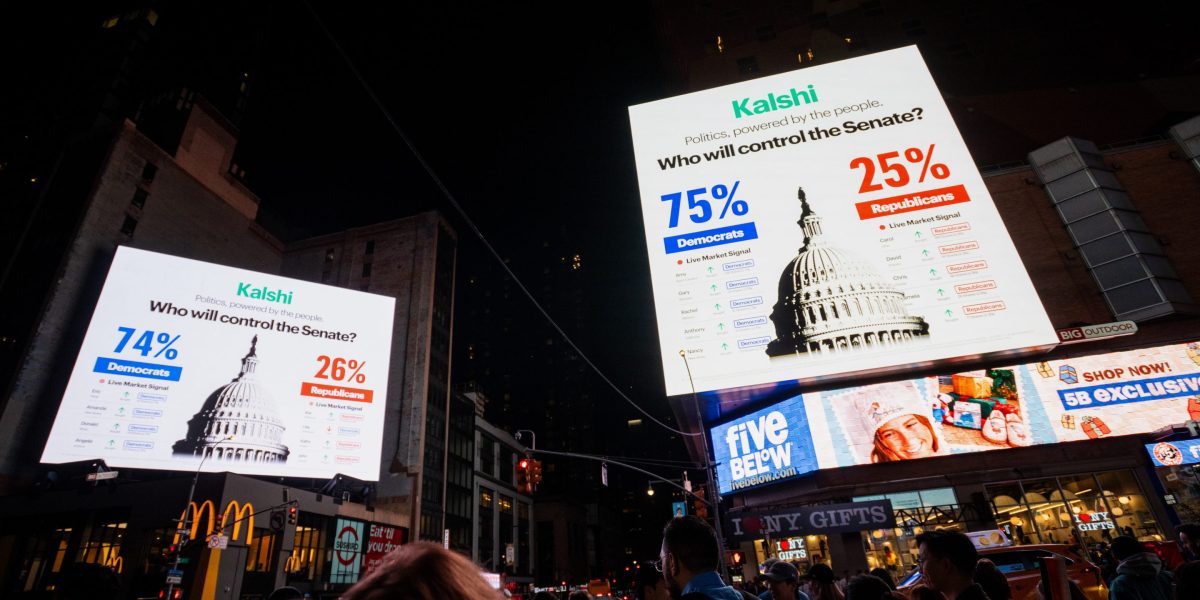
When voters head to the polls to decide the balance of power in government, financial prediction markets transform political sentiment into cold, hard cash. Ahead of the crucial midterm elections determining control of Congress for the final two years of the presidential term, trading volumes on event-based exchanges reached staggering heights. On Kalshi alone, election-related contract trading surpassed $1.4 billion, reflecting massive monetary bets on the political landscape.
The centerpiece of this speculative surge centered on legislative control. A single contract tracking whether Democrats or Republicans would command Congress attracted over $251 million in volume, while dedicated markets for control of the House of Representatives exceeded $181 million. A consolidated market covering all four potential combinations of House and Senate control topped $112 million. Traders heavily tilted toward a Democratic shift, pricing in high probabilities for a House takeover and a competitive bid for the Senate.
Individual state and municipal contests generated comparable momentum. High-profile matchups—including the Los Angeles mayoral race, Texas's Senate battle featuring Democrat James Talarico against Republican Ken Paxton, and the Texas gubernatorial contest—drew tens of millions of dollars in individual market volume. For political observers, these platforms have evolved from niche interest tools into prominent barometers of public expectations.
High Stakes and High Volatility
The explosive growth in political trading expands upon the breakout momentum prediction platforms experienced during recent presidential election cycles. By allowing participants to buy and sell binary contracts that settle based on real-world outcomes, platforms aim to leverage the "wisdom of the crowd" to forecast political events more dynamically than traditional polling.
However, the reliance on market odds as definitive forecasting tools has revealed notable limitations. Prediction markets have suffered significant missteps in recent cycles, illustrating that heavily skewed odds do not guarantee a outcome. In international contests, such as high-stakes presidential runoffs, overwhelming market favorites have watched their lead evaporate as official vote tallies rolled in. Similar surprises have occurred in domestic state primaries, where candidates backed by 95% market odds were narrowly defeated at the ballot box, forcing market operators to issue gentle reminders that a small statistical probability is never a absolute zero.
The Moral and Regulatory Debate
As election wagering cements its place alongside mainstream financial markets, public backlash has intensified. Critics argue that commodifying civic participation undermines democratic trust, blurring the line between civic duty and speculative finance.
"Gamblers aren't pollsters and no serious journalist should be bothering with this tripe"
Many express deep skepticism toward the economic incentives driving the broader coverage of these platforms, viewing the intersection of gambling and civic processes as inherently problematic.
"Election Integrity and Gambling should not be in the same sentence"
Concerns extend beyond ethics to regulatory oversight. While traditional gambling faces strict state and federal frameworks, event contracts traded on regulated peer-to-peer exchanges occupy a distinct financial niche under federal commodity regulations. Proponents argue that peer-to-peer trading simply mirrors traditional financial markets where participants hedge against real-world economic risks. Opponents, however, contend that mobile access and high-volume marketing normalize predatory behavior, calling for stringent regulatory intervention.
"Shit should be illegal. Regulate these "futures markets trading apps" as the gambling apps they are."
Despite ongoing controversy, prediction markets continue to attract massive liquidity. Whether viewed as an innovative forecasting tool or a troubling extension of speculative culture, the convergence of high-stakes politics and financial markets has permanently altered how public expectations are measured—and traded—on Election Day.

